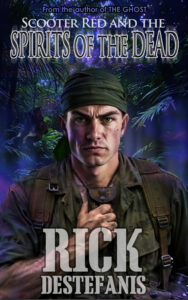
If there’s a way to say something positive, I am going to do it. Life is good. How’s that? I mean this old age gig is a little rough—okay, the pain has no gain—but it beats not feeling anything. Let’s get back on the positive side. I just finished the first draft of my next book in The Ghost Series, Scooter Red and the Spirits of The Dead. It’s currently with the first editor.
Scooter Red: The next book coming in The Long War Home Series.
It’s about a Cajun army sergeant’s unwilling involvement in the Vietnam War. Yeah, it does take some explaining, but that’s why I’m writing the book. That’s a good thing too. With some luck, I hope to have it published before Christmas. I’ll send you a story summary just before it’s published.
They (they being the weather forecast people) promise this dry-roaster heat wave we’ve been stuck in for the last month or two is supposed to end this week. Yes!! We’re going to have a veritable cold spell with temps in the low nineties and high eighties. I’m so giddy, I’m gonna break out the insulated overalls and down jacket. That’s something positive.
I planted the turnip greens, too, which means I’ve got to go to Piggly Wiggly and buy some smoked ham hocks in the next month or two. And I realize those of you who know me are saying my primary vice is fried chicken, but turnip greens cooked with ham hocks and served with skillet-baked cornbread definitely finish in the top ten. That’s a good thing.
Some of you may have noticed my various book advertisements. If you haven’t seen the video ad where Claire Cunningham meets Sam Walker for the first time at the Appalachian State University campus craft fair, check this out. The Birdhouse Man video trailer beginning tomorrow (September 24th) on YouTube at: https://youtu.be/NNdHmiHyhWE I think it’s pretty good. Let me know what you think.
So, I don’t want to drive you too nuts with my positivity, but I’ve always preferred a good Bourbon instead of a whine, which means I must go now. Thank you for reading my blog post, and may the college football team of your choice experience happiness and some degree of success, which means they should avoid playing SEC teams when possible.
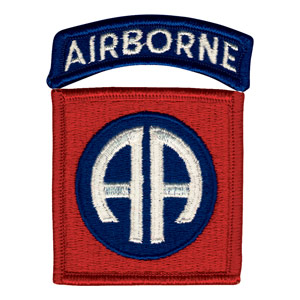
My faithful readers, it is an eventful time to be alive, and many of you have been celebrating the 250th anniversary of our nation’s birth. Let’s hope we can have many more as a free nation. As promised last month, I am clarifying my motivation for becoming a member of the Airborne. For those who don’t know the actual meaning of the term, “Airborne,” it is the official U.S. Army designation for its paratroopers. Although there are other smaller airborne units, the five most recognized are the 75th Army Ranger Regiments, Army Special Forces (AKA Green Berets), 82nd Airborne Division, 101st Airborne Division, and the 173rd Airborne Brigade. I was with the 82nd Airborne in 1970, 1971, and 1972
The All American Patch
My MOS was 11B2P, which meant I was a grunt who jumped out of airplanes, which included a jump from an antiquated C-47, as well as another from a C-119, and a couple dozen jumps from C-130s and C-141s. Oh yeah, I also made a couple low-level jumps from Huey helicopters, and three night jumps, which were “interesting” to say the least. So, this leads me to my promise for this month—that is to explain why I volunteered for such a thing as the Airborne.
You see, I have often been asked, “Why in the world did you decide to become a paratrooper?” or “What possessed you to jump out of a perfectly airplane?” And folks are rightfully curious, but I usually try to keep it light with a little humor. Most of the time I tell them, “When you’re 18 years old, you’re subject to try almost anything.” The truth, however, is it’s not quite that simple.
It was sometime around 1955 to 1959 when my mother used to take us for our “shots” to a pediatrician many miles away out on Jackson Avenue in Memphis, Tennessee. His name was Clifton Wooley.
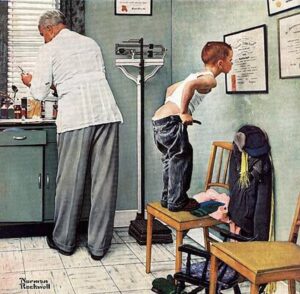
Norman Rockwell’s “Before The Shot”
Think of Normal Rockwell’s painting “Before the Shot,” except I was staring at a framed black and white photo of Dr. Wooley wearing full combat gear and a parachute, standing beside a C-47 aircraft. Mama later showed me old newspaper clippings about Dr. Wooley being awarded the Bronze Star and the Silver Star Medals for heroism. He was my first, but not my last unintended inspiration.
Somewhere around ten or twelve years later, two teammates from my high school football team (who were in the class ahead of mine) joined the Army Special Forces upon graduation. By the time I graduated, one of them was already in Vietnam and the other was in Panama. Both were teammates I highly respected—small in stature but tougher than leather straps. Sergeant Robert Hill finished his service, and we both later worked at the Federal Express World Hub in Memphis. CW5 Buddy (Edward G.) Klein remained in the Army and retired as a highly decorated Master Chief. He lives in Jackson, Mississippi, and we still visit on occasion.
So, you see, I had three examples of what real men did when they were called to duty. Besides, I hated the idea of hiking or riding in a boat to get to a fight. Little did I know, the Airborne runs everywhere: to first formations, to the mess hall, to sick call, the latrine, the training areas—you name it. We never walked when outside of a building. We ran.
NEWS on the author business: I have lowered the price on all my English language e-books on Amazon to $5.99. For whatever reason, Amazon has decided to make them less likely to appear with various search words. I am hoping the price reduction will increase sales and perhaps give Amazon a reason to make them more visible. You can use the link below to reach my Amazon Author page where all the books can be seen and purchased.
More news: For those who like to just close your eyes and have your book read to you. I used the Amazon virtual voice system to record Valley of the Purple Hearts as an audio book, and it’s available at Amazon.com or Audible Books.
If you have an interest in purchasing a signed hardcover of any of my books, email me. I have a limited number, and at this point I make no promises. If I receive requests, I will send an estimated cost to those who send me messages with their requests. Send your request to rickdestefanis@gmail.com with “Hardcover Book Request” in the subject line. I will respond one way or another.
Send your comments. I would like to hear from you.
I’ve often been asked, “Why do I write fiction instead of non-fiction?” It’s an understandable question, especially since it most often comes from my most prolific readers: active military, military veterans, and those in military families. I believe their questions arise from reading novels that are little more than pulp fiction war stories. Romanticizing combat is no better than romanticizing pornography. That is to say readers expect more facts and less sensationalism, but there’s more to it than that alone. In order to provide a better answer, I will reference another author, one of the first Americans to write about the combat experience using the format of the novel.
That author, Stephen Crane, was one of the first to write a novel about the combat experience, not in glorified terms of noble flag-waving charges, but from the common soldier’s perspective. In his novel, The Red Badge of Courage, Crane took his readers beyond casualty reports, tactics, and surface responses of soldiers in combat by probing the depths of the soldiers’ hearts and minds. He rejected the romanticization of American Civil War battles for a more realistic perspective as seen through the eyes of his character, a Union Soldier named Henry Fleming. He portrayed the fear and confusion that accompany combat by exploring the inner emotions and psychological reactions of men facing the moral ambiguity of battle. These aspects are lacking in most non-fiction books, AARs (After Action Reports), and even in personal journals.
As I have with many of my characters: Brady Nash, Buck Marino, Billy Coker, Sam Walker, and others, Crane used Henry Fleming to represent the real soldiers he met and interviewed. He did this so well, veterans later praised his novel for its realism, and some even refused to believe Crane hadn’t fought. Crane never served in the military, something that makes The Red Badge of Courage all the more remarkable. His ability to show common men in uncommon circumstances is what made veterans come to appreciate the power of the novel.
This is why you learn about my characters, before the war and after. You will also find a love interest in the form of a strong woman in almost every story. Yes, some of the stories are somewhat fanciful, but never do they sensationalize the combat experience. They don’t depict grinning men with an arm in a sling, a rifle jauntily propped on a knee, or trading high-fives, but instead peel away the facades of glory by showing men quietly returning home to pick up the pieces of their lives.
As many of you already know, going home is a significant element in several of my novels, especially Raeford’s MVP, Valley of The Purple Hearts, and The Birdhouse Man. If you’ve read one, send me your comments. I’d like to know if you found them worthwhile. Your comments and written reviews are what keeps me writing.